Upwards Of 45% of Texas-made aerospace and energy hardware now are produced with help from CNC milling. This change has made Houston an important center in high-accuracy manufacturing. Nearby producers and product engineers often prefer local machining partners to shorten turnaround times and verify quality on critical components.
Industrial Machining Services Houston
This article reviews CNC Milling Houston and its practical strengths. It explains how local machining providers hold tight tolerances for a wide range of sectors, from energy production to medical devices. Whether you need a Houston CNC machine shop for one prototype or high-volume manufacturing, Houston offers a range of options. Local facilities provide three-, four-, and five-axis milling, live-tool turning centers, and wire and probe EDM capabilities.
Lowrance Machine is a leading provider of precision work in the area. Visit www.lowrancemachine.com to outline your part specifications, material choices, and delivery timeline with an experienced provider equipped for demanding prototype-to-production programs.
Important Points
- CNC Milling Houston is central to local aerospace, energy, and medical manufacturing networks.
- Houston machining services include advanced 3-, 4-, and 5-axis milling plus wire EDM, probe EDM, and live-tool turning.
- Working with a nearby Houston CNC machine shop can reduce delays and improve communication.
- Lowrance Machine supports small-run and scalable production requirements with inspection-focused quality controls.
- Review shops on available machinery, material knowledge, and ability to scale production.
Why Houston Is A Hub For Precision CNC Milling And Industrial Machining
Houston’s diverse industries drive a constant need for accurate components. Businesses across energy, petrochemical, aerospace, and medical markets need parts with controlled dimensions and traceability. This demand supports regional manufacturers to provide prototypes, assemblies, and repeat orders.
Thousands of manufacturers in the Houston area support a robust supplier network. CNC providers can collaborate with regional support shops for coatings, heat treat, and inspection work. That supplier base shortens delivery times, supporting fast design changes for high-detail components.
Houston remains an important center for energy-field hardware manufacturing, with ready access to pipeline infrastructure and the Port of Houston. The city’s transportation advantages make easier the transport of oversized and heavy parts to domestic and international buyers. This efficiency supports both prototype and large-scale production needs.
NASA’s Johnson Space Center and a strong aerospace cluster of over 150 companies create steady demand for aerospace hardware and testing fixtures. Precision milling teams in Houston find consistent work in machining fixtures, aircraft brackets, and medical components. These projects call for accurate finishing and detailed documentation.
Local infrastructure strengthens high-capacity Houston machining services. Ready access to suppliers of raw materials, toolmakers, and inspection labs cuts transit delays. That speed is critical for energy and life-science markets, where part qualification is swift.
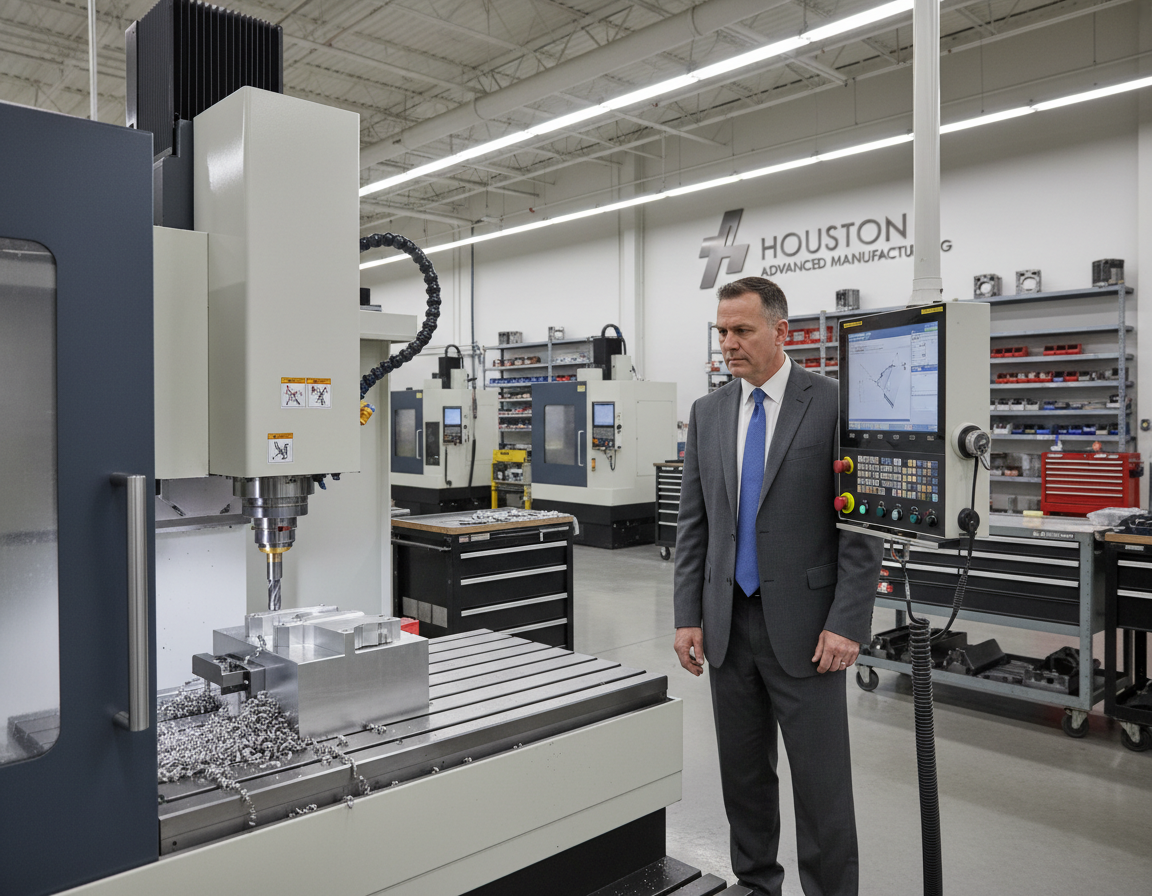
CNC Milling Houston
Computer numerical control milling converts CAD models into accurate metal and plastic components. The process relies on CNC-driven multi-axis mills. Houston shops apply high-efficiency cutting paths and fast spindle systems to produce close tolerances with clean finishes. Those capabilities support aerospace parts, medical devices, energy hardware, and subsea components that need accuracy and small-feature control.
The most advanced facilities integrate five-axis equipment with rotary support. The combined configuration supports compound surfaces to be produced with fewer setups. It reduces changeovers and shortens lead times for prototypes and production runs. Turn/mill tooling and high-speed cutting enable teams to handle compound features and close-radius details with precision.
CNC Milling Definition And Core Capabilities
CNC milling relies on programmed tool movement to cut away material with controlled cutters and end mills. Multi-axis control enables combined tool movement on three to five axes. That makes possible the machining of deep pockets, angled faces, and undercut features in a single setup. CAM strategies like high-efficiency roughing and adaptive clearing improve material removal and tool longevity.
Typical precision shops in Houston hold tolerances suited to aerospace and medical standards. Precision production uses stable spindle platforms, thermal controls, and in-process probing for on-machine checks. This equipment ensure parts maintain repeatable dimensions and stable geometry across production lots.
Equipment And Capacity Found In Houston Shops
Area CNC machining operations run machines from major machine-tool manufacturers such as DMG MORI, Mazak, and Haas. Machines such as DMG MORI NVX and NLVX mills handle 4-axis work with rotary tables for medium-to-large parts. Investments in models like the NVX 7000 support growth from early prototypes to production volume.
High-capacity machining centers machine oversized industrial components for subsea parts and pressure housings. Shops emphasize machines that stay accurate across big work envelopes, using heavy-duty tables and gantry structures. The larger work envelope limits outside handling of oversized components and helps preserve local accountability.
| Shop Capability | Common Hardware | Practical Advantage |
|---|---|---|
| Three-, four-, and five-axis milling | DMG MORI NVX, Mazak VARIAXIS | Complex geometry in fewer setups |
| Oversized-part machining | Gantry mills, Bridge-type centers | Precision work on large components |
| Live tooling & turning | Turn/mill centers, live-tool lathes | Combined mill/turn operations; fewer handoffs |
| High-RPM spindles | High-RPM spindle units | Cleaner finishes and quicker machining |
| In-process measurement | Renishaw probes, on-machine measurement | Real-time confirmation of critical dimensions |
Complementary services in a full-service CNC machine shop Houston include Houston CNC lathe machining for turned features and secondary operations. Pairing turn/mill work with milling cuts handling between machines and reduces total manufacturing time.
Selecting a nearby machining partner with reliable equipment and multi-axis capacity helps engineers meet tight specs and move projects forward faster. Experienced setups, smart tooling, and current machinery create the foundation of strong Houston CNC milling services.
Precision Manufacturing Services Offered By Lowrance Machine
Lowrance Machine excels in delivering from prototype to production, with attention to tight tolerances, reliable delivery, and inspection records. The company brings a blend of computer-controlled and hands-on machining, supporting short runs, complex parts, and regulated industries. The operation pairs modern automation with hands-on skill to satisfy tight tolerances and schedule demands.
Comprehensive CNC Milling And Machining Services
As a trusted CNC machine shop in Houston, this machining partner supports milling, turning, and complex assemblies. The shop handles multi-axis milling, live tooling turning, and long-bed turning for larger or elongated workpieces. Wire EDM and probe EDM services allow precise internal features that are not always practical with conventional tooling.
Gun and BTA drilling cover diameters from 0.25 inches to 3.75 inches and extended depths for specialized hole-making. In-house secondary operations include heat treating, plating, powder coating, and painting so finished parts are closer to installation-ready. These value-added finishing steps shorten turnaround and simplify supplier management.
Manual machining services in Houston are provided for jigs, fixtures, and low-volume runs. Hands-on specialists manage close fitting, trial assembly, and individual part changes that complement CNC production. The combination of CNC and manual work supports fast prototypes and easier production ramp-up.
Certifications And Quality Systems
The quality process at Lowrance Machine focuses on traceable processes and robust inspection. The operation can combine CMM checks, SPC records, and probe EDM verification to support consistent results. These controls help customers in aerospace, medical, and heavy-industry markets that require inspection documentation.
Regional machining providers commonly reference AS9100D and ISO 9001:2015 to demonstrate their commitment to quality systems. Midway Machine provides one market example of a regional shop holding aerospace and general quality certifications, which illustrates common expectations across the market. The Lowrance Machine workflow is structured to recognized quality practices to help satisfy audit and compliance needs.
| Service | Core Capabilities | Benefit |
|---|---|---|
| Precision CNC Milling | 3- to 5-axis milling, high-speed spindles, hardened material strategies | Detailed shapes, close tolerances, and repeatable production |
| Turning & Live Tooling | extended turning, live-tool cutting, and multi-turret capacity | Reduced setups, efficient small- to medium-volume production |
| Electrical-Discharge Machining | EDM cutting and verification for hard-to-reach features | Fine detail, burr-free finishes, hardened steel capability |
| Specialized Deep Drilling | 0.25-inch to 3.75-inch gun/BTA drilling with long-length options | Accurate deep bores for functional parts |
| Manual Support Work | manual fitting, fixture work, and assembly checks | Fast prototypes and practical adjustments |
| Measurement And Quality Assurance | coordinate measurement, SPC, probing, and inspection reports | Improved traceability and fewer quality escapes |
| Secondary Finishing Support | heat treating, plating, powder coating, painting, and zinc phosphating | Assembly-ready components and reduced subcontracting |
Working with a supplier that combines complete Houston machining services with strong process controls compresses schedules and reduces project risk. Lowrance Machine pairs current Houston CNC machine shop equipment with hands-on manufacturing experience to serve first articles, volume work, and regulated industry needs.
Materials And Industries Supported By Houston CNC Machine Shops
Machine shops in Houston machine a wide range of metals and engineered plastics. These shops support tight dimensions and rugged operating conditions. By pairing hands-on skill with CNC automation, they deliver parts for both rugged sectors and high-accuracy markets.
Below is a detailed look at frequently machined materials and the sectors using them.
Materials Houston Shops Commonly Machine
Carbon steels and alloy steels are key for industrial energy applications, making up pressure-rated housings and flow-control components. Stainless alloys is selected because of its corrosion resistance and cleanability.
Aluminum, brass, bronze, and copper are used for components needing conductivity, weight savings, and practical strength. Nickel-based materials handle hot, corrosive, and demanding service environments in subsea and refinery settings.
Specialty plastics such as PEEK, Delrin, and UHMW are machined into parts needing wear control, reduced friction, and chemical resistance. These are essential in assemblies requiring lighter parts or chemical compatibility. Manual machining in Houston makes possible hand-finishing of soft and specialty materials, ensuring the last-stage fit and tactile quality.
Major Industries And Application Examples
Oil and gas companies require subsea hardware, valve bodies, and pressure housings. Those components demands rugged machining, straightness control, and complete inspection records.
Defense and aerospace customers need flight hardware and test fixtures with strict expectations. CNC Milling in Houston helps achieve controlled GD&T requirements on complex aerospace parts.
Medical manufacturing teams require biocompatible metals and plastics. Regulated medical buyers often expect strict cleanliness and inspection protocols. A dependable Houston machine shop helps with traceable lots and detailed records for compliance needs.
Industrial, marine, and agricultural producers also use CNC machining. Their applications call for pump parts, custom tools, and corrosion-resistant fittings. The regional market’s broad material capability meets regional demand, including steel grades, aluminum, copper-family alloys, nickel alloys, and specialty plastics. Such materials serve aerospace, biomedical, subsea, energy, marine, and agricultural sectors.
Capabilities That Strengthen Lead Time And Quality
Current-generation Houston machine shops are reshaping lead times and part quality with cutting-edge machines and streamlined workflows. High-speed multi-axis mills, heavy horizontal centers, and long-bed lathes reduce production bottlenecks. The equipment mix, combined with internal finishing and quality inspection, delivers quicker and more repeatable outcomes for clients in various sectors.
Advanced Milling And Turning Machines
High-speed 4-axis and 5-axis mills with rotary tables help shops produce difficult shapes with fewer operations. The result is shorter machining time and minimizes errors. That equipment are required by CNC Milling Houston shops serving industries with tight tolerances.
Heavy-duty horizontal mills, like the Okuma MB-8000H, machine oversized workpieces. These machines can support up to 4,400 lbs and provide large work tables. That allows a single machining cycle can avoid several smaller machine setups. Long-bed turning Houston capacity is handled on lathes like the Okuma LB line, supporting long shafts and housings up to very long between-center lengths.
Modern lathes with live tooling enables combined turning and milling. That cuts part handling, reduces cycle time, and limits alignment errors. Shops specializing in CNC lathe machining Houston apply live-tool capability to complete mixed-geometry parts in fewer operations.
Efficiency And Finishing Options For Production
Production efficiency improves when CNC Milling Houston equipment is supported by efficient workholding and automatic tool changing. Pallet systems and gantry loaders keep machines cutting while operators prepare the next batch. The outcome is higher throughput and predictable lead times.
In-house finishing shortens delays from subcontractors. Typical choices include heat treating, plating, powder coating, painting, and zinc phosphate. One-stop Houston machining services helps customers get finished components ready for assembly without juggling different subcontractors.
| Production Capability | Representative Equipment | Practical Result |
|---|---|---|
| Fast five-axis milling | DMG Mori DMU and Haas UMC | Complex shapes in single setup; superior surface finish |
| Large horizontal machining | Okuma heavy horizontal platform | Fewer setups for heavy components |
| Extended-bed turning | Okuma and Doosan long-turning platforms | Efficient shafts and housings over long lengths |
| Live tooling lathes | Okuma live-tool turning platforms | Combined turning/milling reduces setups and handling |
| In-house finishing | Heat treat ovens, plating lines, powder coat booths | Reduced outsourcing and more predictable finish quality |
Working with shops with this breadth of machinery compresses schedules and supports consistent output. For work that demands tight tolerances plus fast turnaround, partnering with shops that offer CNC Milling Houston, CNC lathe machining Houston, machining services Houston, and extended turning can create stronger schedule control and better product consistency.
What To Look For When Choosing A Houston Machining Service
As you compare machine shops, align technical capabilities with your part’s needs. Confirm the machine envelope, weight capacity, and available axes can handle your components. This is critical for oversized or heavy parts, where machines like large gantry mills or long-bed lathes are necessary. Check the vendor’s ability to perform multi-axis milling for compound surfaces and live-tool machining for mixed turned and milled features.
Then review the vendor’s process experience. Ask about wire and probe EDM, gun/BTA deep-hole drilling, and manual machining services Houston for special jobs, repairs, or one-off work. A provider offering these services demonstrates flexibility in both prototype and production environments.
Review the quality systems and metrology equipment in place. Ask about ISO 9001:2015 or AS9100D certification and coordinate measuring machines, comparators, and traceable measurement tools. Midway Machine’s AS9100D / ISO 9001 certification reflects the area’s aerospace-level quality expectations.
Consider the vendor’s communication speed and estimating accuracy. Detailed quotations with clear assumptions that identify fixtures, machine time, and quality checks point to strong estimating and engineering capabilities. A provider that can begin with prototypes and grow into production points toward a stronger ongoing manufacturing partner.
Value full-service support to compress schedules and reduce coordination costs. In-house heat treat, plating, and finishing limit subcontractor delays and simplify logistics. A single-source process aids in keeping Houston CNC milling and other machining timelines on track.
Build a simple comparison checklist to compare candidates’ capacity and equipment. Confirm maximum part size, spindle power, available axis configurations and whether they run a complete CNC machine shop Houston operation plus manual machine-shop services in Houston for varied requirements.
Finally, value consistent updates and traceable records. Regular updates, documented inspections, and a single point of contact make complex jobs easier to manage. Choosing a machine shop Houston should function like bringing in an engineering partner and not just a vendor.
Cost, Lead Time, And Scalability For Machine Shop Houston Projects
Understanding the cost and lead time is essential for buyers, engineers, and project managers. Price and timing are shaped by material selection, machining complexity, and surface expectations. Accurate specifications are important to reliable pricing.
Factors Affecting Price And Timing
The selected alloy or plastic can greatly influence both manufacturing cost and machining duration. For instance, aluminum machines faster than stainless steel, which can change tool wear and affect cycle time. Intricate shapes and deep internal features also increase production duration. Additional finishing steps like anodizing or cryogenic deburring increase schedule time and increase handling costs.
Production volume has a major effect on price. One prototype incurs setup and programming costs. By comparison, production lots divide setup expense across more pieces. High-volume work allows for custom workholding and optimized tooling, shortening each production cycle. Complete models, drawings, and tolerance notes improve quoting accuracy and reduce delay in supplier responses.
How Scaling From Prototype To Production Works
Growing from one-off work to production depends on controlled equipment, fixtures, and inspection steps. Providers like Lowrance Machine rely on multi-axis equipment and high-capacity milling platforms. That equipment base ensures quality as volumes increase, lowering risk in moving from prototypes into production.
Ways to reduce cost include turn/mill operations, optimized CAM paths, and dedicated fixturing. These steps cut handling and lower per-part cycle time. Specifying materials and coatings that limit additional processing helps control price. Houston CNC milling capability, when applied smartly, can remove some follow-up work by completing features in a single setup.
Quoting and lead-time commitments are strengthened by precise information. Give the shop complete models and drawings, specific inspection requirements, and room for supplier-recommended machining improvements. Good communication with a shop reduces back-and-forth, leading to more predictable delivery and cost outcomes.
| Cost Driver | Cost Impact | Impact On Lead Time | How To Mitigate |
|---|---|---|---|
| Material (aluminum vs stainless) | Aluminum lower; stainless higher due to tool wear | Harder materials often increase machining time | Choose alloy with similar properties that machines easier |
| Part complexity and features | Detailed geometry raises CAM, setup, and run expense | Complex features can add production time | Apply multi-axis CNC Milling Houston to reduce setups |
| Tolerance and surface-finish requirements | Strict specifications increase QA and machining cost | Precision work requires slower cycles and more QA time | Match tolerance to function and avoid unnecessary fine finishes |
| Volume | Larger runs reduce unit cost by spreading tooling expense | Bigger runs may need more fixture prep but reduce each-part time | Plan runs to benefit from tooling amortization |
| Secondary processes | Heat treat and plating can add outside-vendor costs | Each operation adds transit and queue days | Choose materials and finishes that minimize extra steps |
| CAM and fixture optimization | Better CAM and fixtures reduce per-part cost | Optimized processes cut cycle time | Use machining services Houston expertise to improve CAM and fixturing |
Final Thoughts
Houston’s manufacturing scene is well suited to Houston CNC milling projects needing tight tolerances with reliable delivery. Houston providers use advanced equipment from brands like DMG MORI and Okuma. Many also provide EDM, long-bed turning, live-tool lathes, and finishing services. This setup allows for smoother progress from first article to repeat manufacturing.
When choosing a Houston CNC machine shop, check part specs, volumes, and inspection plans. Look for certifications like recognized standards such as ISO 9001 and AS9100D. Transparent pricing and delivery expectations are important for preventing delays. They help ensure the chosen shop can support your work as quantity or complexity increases.
For machining services Houston that include assembly support and finishing, review full-process capability and communication quality. Lowrance Machine supports the complete path from first article through repeat production. They offer quotes and capability reviews to match your tolerance, material, and delivery requirements.
Related: Houston’s Approach to Multi-Axis CNC Milling for Complex Parts